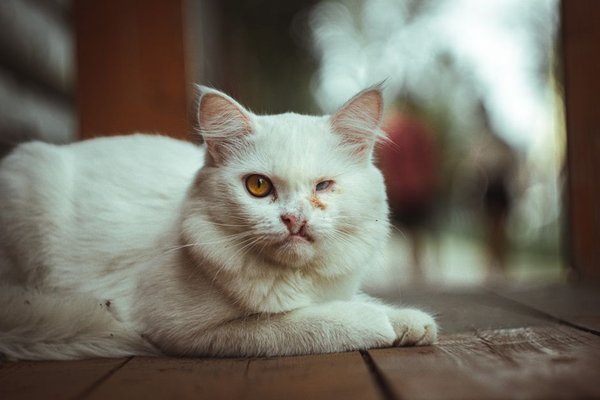
Your cat is curled up across the room, watching you with half-closed eyes. Then the eyelids drift shut for a moment before opening again. It can feel like a tiny, private greeting. So what is the cat slow blink meaning, and should you blink back?
A slow blink often accompanies a calm, comfortable interaction. It may be one of the gentlest ways cats exchange positive social signals with people. But it is not a promise of affection, an invitation to touch, or a behavior every cat will perform. The surrounding body language matters just as much as the eyes.
What Does a Feline Slow Blink Look Like?
A feline slow blink is different from an ordinary reflex blink. The cat gradually narrows its eyes, sometimes makes a few partial blinks, and may close them briefly before opening them again. The movement tends to look unhurried rather than rapid or forced.
You might notice it while your cat rests on a windowsill, sits beside you on the sofa, or watches you from a favorite perch. Sometimes there is a single slow closure; other times it becomes a little sequence of narrowing and reopening.
Because cats also blink to protect and moisten their eyes, one blink alone cannot reveal an emotion. Look for a relaxed setting and a pattern of easy, comfortable behavior before interpreting the gesture socially.
Why Cats Slow Blink at People
The most useful interpretation is that slow blinking can be part of positive, low-pressure cat eye communication. A cat that feels reasonably secure does not need to maintain a hard, watchful stare. Softening the eyes may signal a peaceful interaction rather than confrontation.
That is why people often describe the gesture as a feline expression of trust. It is a helpful shorthand, provided we do not turn it into a literal translation. Your cat is not necessarily saying “I love you” in human terms. It may simply be comfortable enough to relax its gaze while you are nearby.
Comfort does not always mean “come closer.” A cat may slow blink from its chair, then retreat when someone approaches to pet it. Those reactions are not contradictory. The cat may welcome quiet visual contact while preferring to keep its personal space. This distinction is especially useful with timid cats: a friendly acknowledgment is not automatically a request for handling.
What Research Says About Slow Blinking
Slow blinking is more than a charming anecdote. A 2020 study published in Scientific Reports examined eye-narrowing exchanges between cats and humans. In one experiment, cats showed more eye narrowing when their owners directed slow blinks toward them than when the owners were present without interacting.
In another experiment, cats were more likely to approach an unfamiliar researcher following a slow-blink interaction than following a neutral facial expression. The findings suggest that the exchange can support positive cat-human communication.
There are limits to what those results prove. The experiments do not establish that every blink signals love, nor that every cat will respond the same way. They support interpreting slow blinking as a potentially friendly social cue, not as a universal language with fixed meanings.
How to Slow Blink Back Without Pressuring Your Cat
Returning the gesture can be a simple way to offer gentle contact on your cat’s terms. The goal is not to produce a response on command. It is to make yourself seem calm and nonthreatening.
Try this during a quiet moment
Sit or stand a comfortable distance away, ideally when the cat is already relaxed. Let your face soften. Narrow your eyes slowly, close them for a brief moment, and reopen them naturally. Then look slightly away instead of fixing your gaze on the cat.
Wait without leaning forward, calling repeatedly, or reaching out. Your cat may blink back, glance away, remain still, or leave. All are acceptable responses. If it approaches, allow it to choose whether to investigate you or initiate contact.
For example, if a recently adopted cat watches you from beneath a table, try one gentle slow blink and then return to reading. A quiet exchange gives the cat control over the distance. Repeating the gesture urgently or reaching under the table would defeat the point.
Read the Whole Cat, Not Just the Eyes
Cat trust signals work together. A slow blink alongside loose muscles and an easy posture suggests something different from narrowed eyes paired with defensive tension. Learning to notice those combinations is more useful than memorizing a single gesture.
Signs of relative comfort may include a relaxed body, ears resting in a neutral position, and a tail that is still or moving gently. A cat may settle into a resting position or turn its head away without concern. These cues vary among individuals, so consider what is normal for your own cat.
By contrast, flattened ears, a tightly held body, a rapidly lashing tail, growling, or attempts to retreat indicate that you should give the cat space. A rigid, unbroken stare may also occur in tense interactions. For a fuller understanding, compare slow blinking with other signs your cat trusts you and with common cat tail positions.
When Narrowed Eyes Might Mean Something Else
There is an important difference between a relaxed, symmetrical slow blink and persistent squinting. If your cat suddenly holds one eye closed, blinks excessively, paws at an eye, or has redness, cloudiness, swelling, or discharge, do not assume it is communicating affection.
Eye discomfort can have medical causes, including injuries and inflammation. Contact a veterinarian promptly for these signs, particularly when an eye appears painful or the change is sudden. Avoid trying human eye drops unless a veterinarian specifically recommends them.
Frequently Asked Questions
Does a slow blink mean my cat loves me?
It may reflect comfort and a positive association with you, but it cannot confirm a particular emotion. Think of it as one encouraging piece of cat body language rather than proof of love by itself.
Should I slow blink at a cat I have just met?
You can try a soft, brief blink from a respectful distance if the cat appears relaxed. Avoid prolonged staring or moving closer simply because the cat blinks back. Let the animal control the interaction.
Why does my cat slow blink and then look away?
Looking away may be part of keeping the exchange low intensity. It does not automatically mean rejection. Check whether the cat remains loose and settled, and resist the urge to demand another response.
Do cats slow blink at other cats?
Cats may use relaxed eye narrowing around other cats, too. However, the strongest experimental evidence discussed here concerns exchanges between cats and humans. Relationships between cats depend on many additional signals and the situation.
A Small Signal Worth Respecting
The best way to understand cat slow blinking is as a possible invitation to share a peaceful moment, not necessarily physical contact. Respond softly if you like, notice the ears, tail, and posture, and let your cat decide what happens next. That patience often tells you more about feline communication than trying to make every blink mean the same thing.