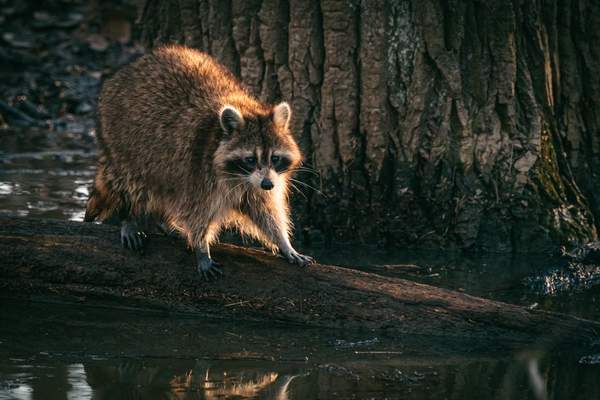
As daylight fades across North America, the landscape changes. A raccoon searches a creek bank, bats sweep above the water, and a fox pauses at a field’s edge to listen. These animals share the night, but they experience it differently. Each relies on a particular combination of senses, feeding habits, and shelter to find food without attracting unwanted attention.
Nocturnal mammals in North America include familiar backyard visitors and elusive forest or desert residents. Looking across species reveals more than a list of night animals: darkness presents different opportunities for a flying insect hunter, a cautious predator, and a mammal that explores the ground with sensitive paws.
Which North American Mammals Are Active at Night?
Raccoons: Hands-On Foragers
Raccoons are generally active after dark, although they sometimes appear in daylight. Their varied diet includes fruit, insects, crayfish, and other available foods. Sensitive front paws help them investigate objects and locate food, especially around water. They also use hollow trees, wooded corridors, and sheltered spaces near neighborhoods.
Bats: Flying Insect Hunters
Many North American bats leave their daytime roosts around dusk to hunt insects. They may fly over ponds, through forests, or along open edges where moths gather. Most insect-eating species use echolocation: they emit high-frequency sounds and interpret returning echoes to detect obstacles and locate prey.
Bats are not blind. They have functional eyes, and echolocation provides another way to navigate when light is scarce. The mechanics of bat echolocation make a fascinating comparison with the hunting methods of ground-dwelling mammals.
Foxes: Listening Before Leaping
Red foxes often forage at night, but they also become active around dawn, dusk, or even during the day. Their acute hearing helps them detect small animals moving through grass or snow. A hunting fox may stop, turn its ears toward a faint sound, and pounce. Smell and careful movement complement its hearing.
Skunks, Opossums, and Small Rodents
Striped skunks commonly search for insects, grubs, and other foods at night or in twilight. They rely heavily on smell and hearing, while their defensive spray discourages many potential predators. A skunk does not need to outrun every threat to protect itself.
Virginia opossums, woodrats, and many mice also travel mainly after dark. Some search for fruit or insects, while others gather seeds and plant material. Their nighttime routines may reduce exposure to daytime predators and, in warm regions, intense sun. Activity patterns still vary with species, season, and weather.
How Mammals Make Their Senses Work in Darkness
Low-Light Vision
Many nocturnal mammals have eyes that make efficient use of faint light. Rod cells in the retina help detect dim illumination, even when color and fine detail are difficult to distinguish. Some species have a reflective layer behind the retina that produces the familiar eye shine visible when light strikes their eyes.
Even good night vision has limits. A moonlit field and a dense forest on a cloudy night are very different environments. Hearing, scent, and touch often provide clues that eyes cannot.
Hearing and Echolocation
For a fox, a rustle might reveal a rodent beneath vegetation. For many bats, echoes provide information about objects directly ahead. These are distinct strategies: the fox listens for sounds prey produces, while the bat sends out calls and interprets what comes back.
Smell, Whiskers, and Sensitive Paws
Smell helps nocturnal wildlife locate food, investigate other animals, and assess familiar routes. Whiskers detect nearby contact, useful when moving through tight spaces. Raccoons add exceptionally sensitive front paws that allow detailed exploration of objects, including food found in shallow water.
These sensory differences explain why nocturnal mammals cannot be described by one simple set of traits. What matters most depends on where an animal travels and how it earns its next meal.
A Shared Night, but Different Habitats
Woodland edges and wetlands offer insects, fruit, shelter, and travel routes. Bats may feed above a pond while raccoons investigate its banks and foxes search the nearby meadow. Several mammals can occupy the same landscape without relying on identical food sources.
In deserts, nighttime activity helps many mammals avoid scorching daytime temperatures. Woodrats and other rodents shelter in nests, burrows, rock crevices, or shaded places, then emerge when conditions are cooler. Their schedules reflect both feeding needs and the demands of staying safe in a dry environment.
In towns, gardens and parks support insects and small prey, but traffic, artificial lighting, garbage, and pets alter the risks. Animals may adjust where and when they move. The relationship between fox behavior and human activity is a useful example of how flexible wildlife routines can be.
Why Nocturnal Does Not Mean Awake All Night
Nocturnal means primarily active at night, not active during every dark hour. Crepuscular animals favor dawn and dusk, and many mammals shift their schedules with temperature, prey availability, breeding, and disturbance. Seeing a raccoon or fox in daylight does not automatically indicate a health problem.
Even among animals active at night, the busiest periods differ. A bat emerging at dusk and an opossum foraging later may barely overlap. These varying schedules help explain how night animals in North America share space without living identical lives.
How to Observe Night Wildlife Respectfully
Choose a safe, permitted viewpoint near a pond or wooded edge shortly after sunset. Stay on designated paths, keep your distance, and let your eyes adjust rather than sweeping a bright light across animals. Listen for movement in leaves, splashes near the water, or wingbeats overhead. Low-light binoculars can help.
Imagine watching a pond from a quiet path: bats dart over the surface while a small mammal moves along the vegetation below. Instead of approaching, watch where each animal looks for food and which cover it uses. Do not feed wildlife, disturb roosts, or handle bats. Keep pets controlled and seek professional advice if an animal seems injured or dangerously disoriented.
Frequently Asked Questions
What are common nocturnal mammals in North America?
Raccoons, many bats, striped skunks, Virginia opossums, woodrats, and several fox species are familiar examples. Their ranges differ, and some are also active around dawn and dusk.
Can nocturnal mammals see in complete darkness?
No. Eyes require some light to form images. Many mammals see effectively in dim conditions, while bats that echolocate can use returning sound waves when visibility is poor.
Why do mammals come out at night?
Nighttime activity can offer cooler temperatures, food opportunities, and reduced exposure to certain predators or competitors. Which benefit matters most depends on the species and habitat.
Does a raccoon seen during the day have rabies?
Not necessarily. Healthy raccoons sometimes forage in daylight. Avoid touching or approaching any wild animal, especially one that appears sick, injured, or unusually aggressive, and contact local wildlife professionals when concerned.
Conclusion
The night is not a single habitat with a single survival strategy. Echolocating bats, touch-oriented raccoons, listening foxes, and scent-guided skunks demonstrate the remarkable range of nocturnal mammal adaptations. Paying attention to where they travel and how they find food can turn an ordinary evening outdoors into a closer look at North America’s connected wildlife communities.