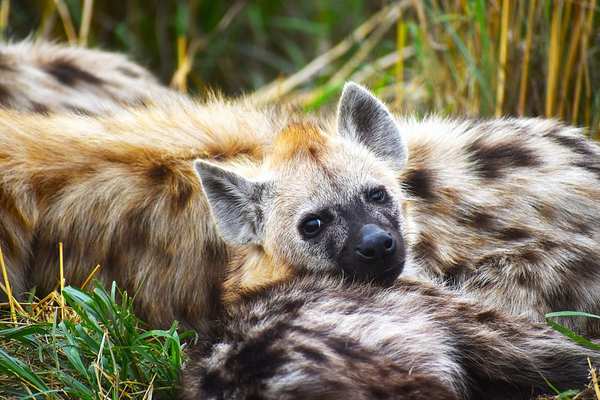
At a kill on the African savanna, spotted hyenas may appear to be squabbling over dinner. Yet beneath the noise lies a society shaped by family connections, alliances, inherited status, and rules about who eats first. Hyena social behavior is far more intricate than the familiar image of a laughing scavenger suggests.
The spotted hyena offers the clearest example. Its clans resemble some primate societies in their enduring relationships and complex politics. Unlike less social hyena species, these predators balance independence with cooperation, a combination that helps explain their calls, hunting tactics, and territorial success.
How a Spotted Hyena Clan Works
A spotted hyena clan is a territorial community that may contain dozens of individuals and, in some populations, as many as about 100. Members recognise one another, defend shared resources, and gather at places such as communal dens. But a clan is not a pack that always travels together.
Instead, spotted hyenas practise what scientists call fission-fusion sociality. Individuals separate to patrol, rest, or forage, then reunite in changing subgroups. Clanmates seen together one evening might spend the next night kilometres apart. Their relationships persist even when they are separated.
This flexibility is central to hyena clan structure. Large gatherings help defend territory; smaller foraging parties limit competition over food. Social membership provides security without forcing everyone to share every meal.
Female Dominance and Family Rank
Female spotted hyenas generally outrank adult immigrant males. Females also tend to be larger, but dominance is not simply a contest of strength. The hierarchy is maintained through social support, repeated encounters, and established relationships.
How Cubs Learn Their Place
Daughters usually remain in their birth clan and acquire ranks close to their mothers. A mother can back her cub during confrontations, teaching others how the youngster should be treated. Researchers call this maternal rank inheritance, but it is largely a social process rather than a rank determined directly by genes.
Rank affects access to food. A dominant female may feed sooner at a carcass, while a subordinate must wait or forage elsewhere. Such differences matter greatly when mothers are raising cubs. Alliances with relatives can also influence the outcome of disputes.
Males often leave their birth clan as they mature and join another, usually entering near the bottom of its hierarchy. Female family lines therefore form the enduring foundation of clan society.
Hyena Communication: More Than a Laugh
Spotted hyenas exchange information through sounds, scents, and posture. A call may signal location, distress, excitement, or social tension, depending on the situation.
Whoops, Giggles, and Greetings
The long, rising-and-falling whoop carries across open country. It helps separated animals maintain contact, and some whoop patterns appear to recruit clanmates when assistance is needed. A rapid, high-pitched giggle does not mean a hyena finds something funny. It often occurs during tense or competitive encounters, particularly around food.
Groans and squeals provide closer-range signals. Reuniting clanmates may sniff one another and perform ritualised greetings involving the genital region. These encounters help maintain social relationships after time apart.
Scent Marks and Silent Signals
Hyenas deposit secretions from scent glands onto vegetation, a practice known as pasting. These marks convey chemical information and help advertise an animal’s presence in an area. Hyenas also investigate marks left by neighbours and rivals.
Ear position, tail movement, and body posture add another layer of hyena communication. A lowered body or retreat can change how an apparently aggressive encounter should be interpreted. Watching the entire animal matters more than listening to its voice alone.
Why Hyenas Hunt Alone and Together
Spotted hyenas are effective hunters, not merely scavengers. They pursue antelope and other hoofed mammals, consume carrion when available, and adjust tactics to local prey conditions. Powerful jaws allow them to use much of a carcass.
Surprisingly, hyena hunting is frequently solitary. Research in Kenya found most observed hunting attempts involved lone hyenas. Cooperation becomes particularly valuable with larger, difficult prey such as zebras, where extra hunters can improve the likelihood of capture.
Picture a hyena pursuing a young antelope while its clanmates forage elsewhere. Later, the same animal confronts a zebra and another hyena joins the chase. This illustrative example captures their flexible approach: the difficulty of the prey helps determine whether teamwork is worthwhile.
There is a trade-off. More hunters may secure a kill, but they must then compete for shares. A successful lone hunter can sometimes eat more than one surrounded by hungry clanmates. African wild dog hunting strategies provide an illuminating contrast because wild dogs depend more consistently on coordinated pack activity.
Territory, Lions, and Rival Clans
One of the greatest advantages of belonging to a clan may be defence. A carcass attracts rivals, and an isolated hyena may struggle to protect it. Clanmates can assemble to confront competitors, making numbers valuable even when individuals usually hunt apart.
Territories are defended through scent marks, calls, patrols, and occasional fights. Neighbouring clans may clash over food or boundaries. Lions are formidable competitors and can kill hyenas, so challenging them is dangerous even for a group.
Here lies a fascinating contradiction in spotted hyena behavior: clanmates compete intensely among themselves yet may cooperate against outside threats. Lion social behavior offers another useful perspective on how African predators manage collective defence.
Communal Dens, Mothers, and Social Learning
Females first give birth in secluded dens before moving their cubs to communal sites shared with other mothers. Youngsters meet, play, and begin discovering the clan’s social rules while remaining dependent on maternal care.
Shared dens do not mean communal nursing. Mothers primarily feed their own offspring with rich milk, sometimes continuing for more than a year. Their social rank can influence how easily they obtain enough food to support growing cubs.
Young hyenas learn by observing conflicts, testing boundaries, and receiving support from relatives. Early experiences shape future relationships. The interaction between inherited status and learned behavior also makes predator communication an especially revealing field of research.
Frequently Asked Questions
Do all hyena species live in large clans?
No. Large, complex clans are characteristic of spotted hyenas. Striped hyenas, brown hyenas, and aardwolves have different social arrangements.
Why are female spotted hyenas dominant?
Dominance is sustained through established relationships and support from relatives. It is linked to food competition and raising young, not merely female size.
Does a hyena’s giggle mean happiness?
No. Giggles commonly accompany excitement, nervousness, or social tension. Context tells us more than the sound by itself.
Do spotted hyenas always hunt together?
No. They frequently hunt alone, especially for manageable prey. Others may join when prey is challenging or when food and territory need defending.
What Hyena Society Reveals
Hyena social behavior cannot be reduced to laughter, scavenging, or aggression. Spotted hyenas maintain lasting family networks while changing whom they travel, hunt, and compete alongside. Their calls connect distant clanmates, rank shapes access to resources, and alliances become crucial during danger. Their society thrives because rivalry and cooperation coexist.