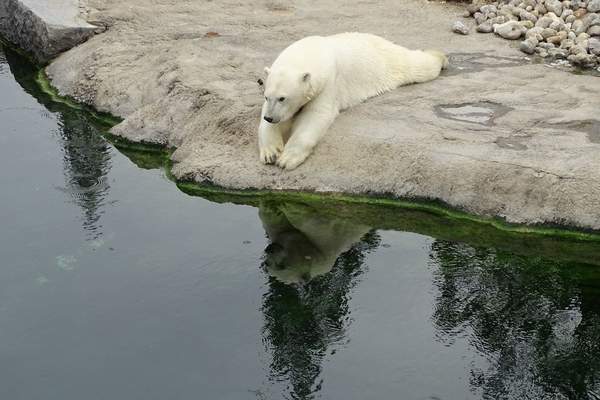
A polar bear standing on frozen water is not simply visiting a snowy landscape. The ice beneath its paws is the foundation of its hunting grounds, travel routes, and daily survival. Polar bear habitat is best understood as a moving marine environment, not a fixed patch of Arctic land.
Where ice forms, how long it lasts, and which seals live beneath it shape a bear’s chances of finding food. That relationship connects nearly every part of polar bear life, from seasonal migration to raising cubs.
Why Sea Ice Defines Polar Bear Habitat
Polar bears are marine mammals that depend heavily on sea ice to reach seals. The frozen surface acts as a hunting platform above the ocean. Bears may wait beside a seal’s breathing hole, investigate a snow-covered den used by seals, or approach prey resting on the ice.
Ringed seals are especially important in many regions, while bearded seals also provide substantial meals. Seal blubber supplies concentrated energy, helping bears build the fat reserves needed when hunting becomes difficult.
Not all sea ice offers equally good habitat. Ice over relatively shallow continental-shelf waters often gives bears access to productive feeding areas. Ice that drifts over deep ocean water may provide fewer opportunities, even if its surface looks perfectly suitable for walking.
Sea Ice and Glacier Ice Are Different
Sea ice forms when ocean water freezes, generally expanding in winter and shrinking in summer. Glaciers form from compacted snowfall on land. Polar bears occasionally use coastal glacier ice, but it usually cannot replace the broad hunting access provided by sea ice. The Arctic food web beneath the ice matters as much as the ice itself.
Where Do Polar Bears Live?
The polar bear range extends around the Arctic through Canada, Greenland, Russia, Norway’s Svalbard archipelago, and Alaska in the United States. Polar bears do not naturally live in Antarctica, despite their familiar association with snow and ice.
The IUCN Polar Bear Specialist Group recognizes 20 subpopulations, including a distinct southeast Greenland group formally recognized in 2025. Some subpopulations span national boundaries, and individual bears may roam widely rather than defend small, fixed territories.
Four Broad Sea Ice Regions
Scientists distinguish several patterns across this range. Seasonal sea ice disappears for part of the year, as in Hudson Bay. Divergent ice moves away from coastlines, leaving open water. Convergent ice is pushed together by currents and may persist longer. The islands and narrow channels of the Canadian Arctic Archipelago have historically supported more lasting ice.
These differences explain why latitude alone cannot tell us whether a location is good bear habitat. The timing, movement, and productivity of the ice are essential.
How Seasons Shape Polar Bear Movement
Winter usually brings expanding sea ice and renewed access to hunting areas. Spring is particularly valuable because seals give birth and nurse pups. Successful hunting then can help bears accumulate energy reserves for leaner months.
Summer changes the equation. In places where ice melts completely, bears spend time on land without dependable access to their usual seal prey. They sometimes eat bird eggs, vegetation, or carcasses, but these foods rarely replace the energy available from seal blubber.
Consider western Hudson Bay near Churchill, Manitoba. Bears commonly come ashore after breakup and wait for autumn freeze-up to resume hunting offshore. An earlier spring breakup or later autumn freeze-up extends the period spent away from seals. Counting ice-free days therefore reveals something that a simple wildlife location map cannot.
Other bears follow the retreating ice north instead of staying ashore. That decision can demand extra travel and may take them over less productive water. Seasonal movements differ substantially from one region to another.
Arctic Bear Adaptations for Ice and Water
Insulation and Energy Conservation
Dense fur and a thick layer of fat protect polar bears against extreme cold. Small ears and short tails reduce exposed surface area. Their insulation works so well that strenuous activity can cause overheating, helping explain why patient, energy-saving hunting is often more effective than chasing prey.
Paws Built for Travel
Broad paws distribute weight across snow. Textured footpads and fur improve traction on slippery surfaces, while powerful limbs make polar bears capable swimmers. Swimming helps them cross gaps in habitat, but prolonged open-water journeys require energy and can be dangerous for cubs.
Senses That Support Hunting
A strong sense of smell helps a bear locate potential prey and investigate seal breathing holes. Pale fur can make its outline less conspicuous against ice. Still, successful hunting depends on ice conditions, seal behavior, patience, and experience, not appearance alone.
These adaptations illuminate how bears survive winter, but none eliminates the need for accessible, energy-rich prey.
Where Polar Bears Den and Raise Cubs
Pregnant females often make maternity dens in deep, stable snowdrifts on land or, in some places, on sea ice. They generally enter dens during autumn or early winter, give birth in winter, and emerge with cubs in spring.
Denning habitat and hunting habitat are related but distinct. Mothers need protective snow and a workable route back to feeding areas. Changes in snow conditions or ice location can complicate that journey, even where suitable den sites remain.
What Shrinking Sea Ice Means for Polar Bears
Arctic sea ice has declined over the satellite record, especially in late summer. For bears, less ice can mean shorter hunting seasons, longer fasting periods, greater swimming distances, and more separation between feeding areas and maternity dens.
The consequences are not identical everywhere. Some subpopulations have declined, while others show different trends or lack enough data for confident conclusions. A healthy-looking bear in one area does not establish that habitat loss is harmless across the species.
Southeast Greenland offers a revealing exception. Some bears there hunt using freshwater glacier ice when sea ice is scarce. Their unusual behavior demonstrates flexibility, but it does not show that glacier ice could replace the extensive seal-hunting habitat required across the Arctic.
Protecting polar bears therefore involves addressing warming and greenhouse gas emissions as well as local issues such as human-bear conflict. Conserving coastline alone cannot preserve a hunting surface that forms and moves at sea.
Frequently Asked Questions
Do polar bears live on glaciers or sea ice?
They primarily rely on sea ice to hunt seals. They also use land and sometimes glacier-derived ice for resting, travel, denning, or limited hunting.
Can polar bears survive without sea ice?
They can survive temporary ice-free periods using stored fat. Long-term loss of reliable seal-hunting access makes survival and reproduction much harder.
Why are polar bears only found in the Arctic?
They evolved in northern marine ecosystems with suitable seal prey and ice conditions. Their natural range is Arctic and sub-Arctic, not Antarctic.
How far can polar bears travel?
Distances vary with food availability, geography, and moving ice. Some use familiar areas; others travel hundreds or even thousands of kilometers.
A Habitat That Moves With the Ocean
Polar bears are adapted to cold, but cold alone does not make a home. Their habitat is a changing meeting place of sea ice, seals, currents, and seasons. To understand where a polar bear can thrive, ask not merely where it stands, but how reliably it can reach food from the ice.