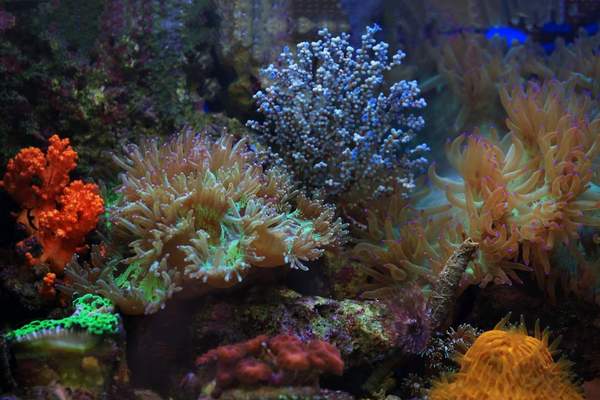
A saltwater aquarium can look healthy while its salinity quietly drifts. Clear water and active fish do not tell you how much dissolved salt is present, yet that concentration influences how marine animals regulate water and salts in their bodies. For a reef tank, stability matters as much as a particular test result.
A practical target for most conventional reef aquariums is 35 parts per thousand (ppt), equivalent to about 1.0264 specific gravity under commonly used reference conditions. Choose a suitable level for your livestock, measure consistently, and avoid abrupt corrections.
What Salinity Range Should a Saltwater Aquarium Have?
Salinity describes dissolved salts in water. Ocean water commonly measures around 35 ppt, meaning roughly 35 grams of salts per kilogram of seawater. Many reef keepers aim for 35 ppt, with a modest range of about 34–36 ppt generally more useful than chasing every decimal place.
Fish-only marine systems sometimes operate at slightly lower salinity, but lower is not automatically better. Species, habitats, and the needs of invertebrates matter. Corals, snails, shrimp, and other reef animals generally benefit from a consistent level close to natural seawater. Brackish species need different conditions and should not be managed using a standard reef target.
Once you establish your target, prevent fluctuations rather than constantly correct them. A reliable routine beats adding fresh or salty water based on one doubtful reading.
Salinity, Specific Gravity, and Conductivity Explained
Three measurements describe related aspects of saltwater, but they are not interchangeable numbers. Salinity is often reported in ppt. Specific gravity compares a liquid’s density with a reference, while conductivity indicates how readily dissolved ions carry electricity.
At around 35 ppt, natural seawater corresponds to approximately 1.0264 specific gravity and 53 millisiemens per centimeter of conductivity at 25°C. These comparisons depend on reference conditions, temperature, and calibration. A specific gravity aquarium reading without knowing the instrument’s scale can mislead.
Pick one trusted method and record results in consistent units. If your refractometer has ppt and specific gravity scales, check that it is intended for seawater.
How to Test Saltwater Aquarium Salinity Accurately
Using a Refractometer
A handheld refractometer aquarium test uses drops of water on a prism. First check calibration with a reputable 35-ppt seawater reference solution. This confirms accuracy near the range you care about; pure-water calibration alone can leave some brine-scaled instruments inaccurate for seawater.
Clean the prism, apply the reference solution, close the cover, and allow temperatures to settle. Adjust or verify the reading according to the manufacturer’s directions. Rinse, gently dry, add aquarium water, wait briefly, and read the boundary line. Avoid touching the prism with salty fingers or letting samples dry on it.
Automatic temperature compensation helps but does not eliminate every source of error. Keep reference fluid sealed against evaporation and recheck accuracy periodically, especially after a drop or an unexpected reading.
Other Testing Options
Digital salinity and conductivity meters provide quick readings when maintained and calibrated with specified standards. Hydrometers are inexpensive, but bubbles, residue, and temperature can affect readings, especially with swing-arm models. Compare questionable results using a second reliable method before changing the tank.
Why Salinity Changes Even When You Add No Salt
Evaporation removes water, not dissolved salts. As the water level falls, the remaining salt becomes concentrated, and salinity rises. An automatic top-off system replaces evaporated water with freshwater, usually reverse-osmosis/deionized (RO/DI) water, limiting daily movement.
Consider an aquarium holding 40 gallons of actual water at 35 ppt. If one gallon evaporates without replacement, the remaining 39 gallons could rise to approximately 35.9 ppt, assuming no other gains or losses. That is a meaningful change caused by ordinary evaporation.
By contrast, wet skimming, salt spray, or water removed during maintenance takes salt out of the system. Repeated freshwater replacement after these losses may gradually lower salinity. Watch both the water level and salt concentration.
How to Adjust Salinity Without Shocking Livestock
When Salinity Is Too High
Confirm the measurement and check for evaporation or an incorrect top-off mixture. Replace evaporated water with plain RO/DI freshwater, never newly mixed saltwater. If salinity remains high at the correct water level, make gradual adjustments by removing measured amounts of tank water and replacing them with freshwater. Retest after thorough circulation.
When Salinity Is Too Low
Look for excess freshwater addition, an overfilling top-off unit, or weakly mixed replacement water. Correct the cause first. Then gradually raise salinity using properly dissolved, temperature-matched saltwater through controlled water replacement. Do not pour dry marine salt into an occupied aquarium; crystals can contact sensitive animals.
For significant errors or stressed livestock, avoid large improvised changes. Species vary in tolerance, so an aquatics veterinarian or experienced marine specialist can help plan corrections.
Build Salinity Checks Into Your Maintenance Routine
Measure regularly, especially in a new aquarium or one without automatic top-off. Checking several times a week and before and after water changes is useful. Record salinity, temperature, water level, and any water added. Trends become clearer when readings have context.
Mix replacement seawater separately according to the salt manufacturer’s directions, allow it to dissolve and circulate, and test salinity before adding it. Match temperature reasonably closely. Track other saltwater parameters, including alkalinity, calcium, magnesium, temperature, and pH; salinity drift can affect how some values are interpreted.
For related maintenance advice, look for guides on saltwater aquarium water changes, mixing marine saltwater, and choosing an automatic top-off system. Each helps prevent a problem before the next salinity test reveals it.
Frequently Asked Questions
Is 1.025 or 1.026 Better for a Reef Tank?
Both readings can support a healthy reef, depending on instrument accuracy and reference conditions. Around 35 ppt, often displayed as approximately 1.026 specific gravity, is a sensible baseline. Consistency matters more than switching between close readings.
Can I Use Tap Water to Replace Evaporation?
RO/DI freshwater is generally preferred because tap water may introduce unwanted minerals or contaminants. Top-off water should contain no marine salt: it replaces evaporation, not water removed from the aquarium.
How Often Should I Calibrate a Refractometer?
Check against an appropriate 35-ppt reference when first using the instrument, periodically afterward, and whenever results look suspicious. Follow the manufacturer’s specific procedure and keep standards tightly sealed.
Why Does Salinity Rise After a Water Change?
The new mix may be stronger than the tank water, or evaporation may have occurred during maintenance. Test the replacement water, restore the intended water level, and retest after circulation.
Keep the Number Steady, Not Just Correct
Good saltwater aquarium salinity management is a set of small habits: choose a livestock-appropriate target, verify the tester, replace evaporation with freshwater, and check newly mixed seawater before water changes. Investigate unexpected results before correcting them. A stable reef comes from consistent maintenance, not constant adjustments.