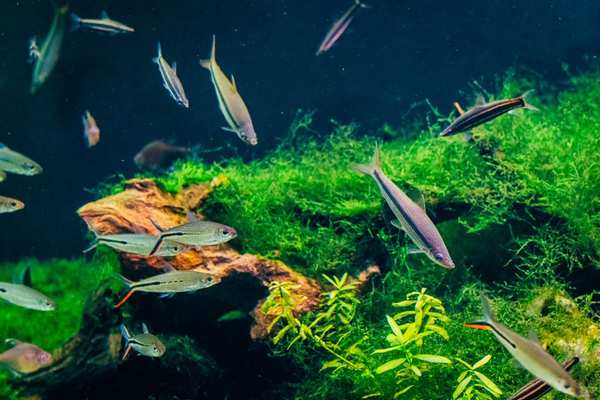
A calm community aquarium is not simply a collection of fish labelled peaceful at the shop. The most harmonious tanks are built around species that can share the same water, have enough space to behave naturally, and feel secure in groups of the right size. A tiny, timid fish can be stressed by an energetic neighbour even when neither species is aggressive.
Check Compatibility Beyond Temperament
Start with adult size, not the size of fish in the sales tank. A fish that looks harmless when young may grow large enough to swallow smaller tank mates. Check body shape and fin behaviour too: persistent chasing and fin-nipping can make otherwise compatible freshwater fish miserable.
Next compare temperature, pH and water hardness. Two species can both be gentle yet need very different conditions. Many tetras and rasboras suit softer water, while guppies and platies generally thrive in harder, more mineral-rich water. Choose fish suited to your actual tap water where possible, rather than constantly chasing a particular pH.
Finally, consider swimming room and social needs. A long tank offers more horizontal space than a tall tank of similar volume. Schooling fish are typically more confident in a substantial group of their own species, and bottom-dwellers still need adequate floor space even when mid-water looks empty.
Reliable Peaceful Fish to Consider
Harlequin Rasboras
Harlequin rasboras are excellent mid-water community aquarium fish. Their copper colour and dark triangular markings show especially well against plants. Adults reach roughly 4–5 cm, and a group of eight to ten or more is a sensible starting point in an appropriately sized tank. They usually coexist well with calm catfish and small gouramis when water conditions overlap.
Ember and Neon Tetras
Ember tetras offer a delicate orange shimmer, while neon tetras provide a contrasting blue-and-red stripe. Both need companions of their own kind; aim for at least eight to ten rather than scattering a few individuals among several tetra species. Embers are particularly small, so avoid larger fish that might treat them as food. Check each tetra species’ preferred temperature before mixing them.
Corydoras Catfish
Corydoras bring activity to the bottom without behaving like territorial scavengers. Keep a group of at least six of the same species, preferably on fine, smooth sand that supports natural foraging. Sterbai Corydoras tolerate warmer tropical conditions than some other commonly sold cory species, making identification important. Offer sinking food; leftovers from the fish above are not a complete diet.
Honey Gouramis
A honey gourami can provide a gentle focal point above a shoal of smaller fish. It appreciates subdued areas, plants and access to the surface. One can work well in a community setup, although personalities vary and breeding behaviour may cause territorial displays. Do not assume every brightly coloured gourami sold under a similar name has the same temperament.
Build a Community Around Shared Water Conditions
Instead of shopping by colour, make a shortlist with the preferred temperature and hardness of each candidate. Look for a comfortable overlap, not merely the edges of their published tolerance ranges. Stable conditions within that overlap are usually safer than frequent adjustments to satisfy several incompatible preferences.
As a practical example, imagine a well-established, planted aquarium of about 110 litres (29 US gallons) with a good horizontal footprint. A potential plan is ten harlequin rasboras in mid-water, six Sterbai Corydoras on the bottom, and one honey gourami near the surface. Aim for stable water around 25–26°C if its chemistry suits all three, and confirm the aquarium’s filtration, swimming space and maintenance capacity before stocking.
The point is not that this combination is universally guaranteed. It is that each species has a clear role, adequate companions and broadly overlapping needs. Add one group at a time after the tank is cycled, monitor water tests, and adjust if individuals show stress. A shorter aquarium or one with less usable bottom area may need a lighter plan.
Why Group Size Is Often More Important Than Variety
A display with two neons, three rasboras, two Corydoras and one barb may look diverse on paper. To the fish, it can mean constant uncertainty. Social species often become skittish or unusually withdrawn when kept in small groups. Some may chase unrelated fish because their normal interactions have been disrupted.
For a modest aquarium, choose one substantial shoal rather than multiple incomplete ones. Add a bottom group only if the footprint and biological load allow it. Fish that move confidently together can make the entire aquarium look calmer than a crowded mixture of solitary, nervous individuals.
Make the Tank Feel Safe
Even ideal peaceful tank mates can struggle in a bare, brightly lit aquarium. Tall plants along the back, floating cover in selected areas, and wood that breaks up sightlines let fish retreat without losing open swimming room. Corydoras need accessible substrate rather than a floor completely covered with ornaments.
Use a dependable freshwater aquarium cycling guide before introducing livestock. A cycled filter, ammonia and nitrite readings at zero, and regular nitrate monitoring are essential; friendly fish cannot make an uncycled tank safe. A straightforward routine for testing aquarium water also helps reveal problems before behavioural changes become obvious.
Warning Signs That Tank Mates Are Not Getting Along
Occasional brief chasing is not always an emergency, but repeated pursuit, torn fins, hiding all day, skipped meals and fish clustering in one corner deserve attention. Check water quality first, because poor conditions can resemble compatibility problems. Then observe interactions at feeding time and after the lights come on.
Frequently Asked Questions
What are the easiest peaceful community fish for beginners?
Harlequin rasboras and appropriately chosen Corydoras are popular starting points in a properly cycled aquarium. Both still require groups, suitable water and enough space. Choose species based on your tank dimensions and water hardness rather than assuming every beginner fish belongs together.
Can guppies live with neon tetras?
They may coexist peacefully, but guppies usually prefer harder, more alkaline water than neon tetras. Only combine them if you can provide stable conditions genuinely suitable for both. In many cases, building separate hard-water and soft-water communities is easier.
How many schooling fish should be kept together?
Six is a common minimum for some species, but eight to ten or more often makes a better starting group for small tetras and rasboras when the tank has space. Always check the particular species rather than applying one number to every fish.
Are bottom-dwelling fish a substitute for tank cleaning?
No. Corydoras and other bottom fish produce waste and need their own food. They may eat fallen particles, but you still need water changes, substrate maintenance and appropriate filtration. Never add them solely as a cleanup crew.
A Peaceful Aquarium Starts With Restraint
The most successful community is usually not the one with the longest species list. Pick fish that share comfortable water conditions, give social species proper groups, and leave enough room for each to use its preferred part of the tank. Plan around their adult lives, and a calm-looking aquarium becomes a calmer place for its inhabitants too.